A young boy in class leaning to the side, trying to see the board.

Myopia at a glance.

Also referred to as short-sightedness or nearsightedness, myopia usually occurs when the eye is longer than average or the cornea or lens bends light too strongly. Light entering through the eye is focused in front of the retina instead of directly on it as a result. This causes blurred vision in the distance.

There’s no cure for myopia. Spectacles, contact lenses and laser vision correction can help correct the refractive error – helping people see faraway objects clearly again. If left uncorrected, short-sightedness can worsen over time. Cases of high myopia may even lead to severe eye diseases and structural damage.

Myopia is the most common refractive error in the world today. According to estimates, nearly half of the global population may be myopic by 2050. This global health issue especially affects children and adolescents. While individual characteristics as well as lifestyle and environment may impact whether or not a child becomes myopic, effective treatments can help slow its progression. 

What is myopia?

Myopia is the most common refractive error worldwide.1,2 By 2050, it’s estimated that 50% of the world’s population may be myopic, making it a global pandemic.3

In myopia, incoming light focuses in front of the retina instead of directly on it. This usually happens because the eye is slightly longer than average (axial myopia) or because the cornea or lens focuses light too strongly (refractive myopia).4

As a result, distant objects look blurry while nearby objects remain relatively clear. Contrast seems less sharp and images look a bit smaller when viewed through corrective lenses.5-7 These effects can be challenging when driving at night, for example. Children may find it more difficult to read the board in the classroom or play team sports.

Most cases of myopia don’t lead to severe eye disease. The risk of developing more serious eye issues increases with myopia of -5.00 diopters or greater.4,8 This stage is called high myopia. It may progress to pathologic myopia in some cases, which indicates that structural eye damage has already started. Pathologic myopia can involve conditions such as retinal detachment, myopic maculopathy and certain types of glaucoma and cataracts.4

What causes myopia?

Researchers don’t fully understand the causes of nearsightedness. They assume, however, that myopia arises from a combination of genetic, behavioural and environmental factors.

Individual characteristics
Genetics, ethnicity and gender play significant roles in the development and progression of myopia. If one or both parents are myopic, there is a higher likelihood that their children will also develop myopia.9

Lifestyle and environment
Lifestyle factors are also instrumental. Recent studies show that spending many hours on near work – such as reading, studying or using digital devices – increases children’s risk of developing myopia.10 In contrast, spending more time outdoors seems to have a protective effect.11 Regular exposure to natural light, ideally up to two hours daily, helps to slow the onset of myopia.12

Other eye conditions
Myopia can appear or worsen later in life due to other conditions. When cataracts form, for example, the lens inside the eye becomes denser and changes how it focuses light.13 Sometimes, this temporarily improves near vision without reading glasses. Referred to as “second sight”, it’s usually short-lived. Gradual vision loss eventually follows, which can be reversed with cataract surgery.

A young boy in class having difficulties seeing the board clearly.

Does my child have myopia?

Wondering whether or not your child has myopia? These signs could indicate that your child is nearsighted:

  • Problems reading boards or screens in class
  • Holding digital screens or books close to the face to see clearly
  • Frequent squinting
  • Regular headaches
  • Rubbing the eyes frequently

Remember: Children aren’t always aware of these signs. They may not know the difference and assume their vision is “normal”. If you notice any of them, it’s best to consult an eye care professional.

Symptoms that require urgent checks.

Most people with myopia just have blurred distance vision. But those with high myopia have a greater chance of developing serious eye problems. If you notice any of these warning signs, see an eye doctor straightaway.
You may start seeing tiny moving spots or threads. These are usually caused by “clumps” of vitreous, a gel present inside the eye.
A point of view of a child looking at a school board and seeing floaters.
Flashes of light or the feeling that a dark curtain or shadow is blocking part of your side vision.
A point of view of someone looking at a group of people with the side vision being disrupted by shadows.
Straight lines appear to be wavy or distorted.
A point of view in a class room where normally straight lines appear wavy.
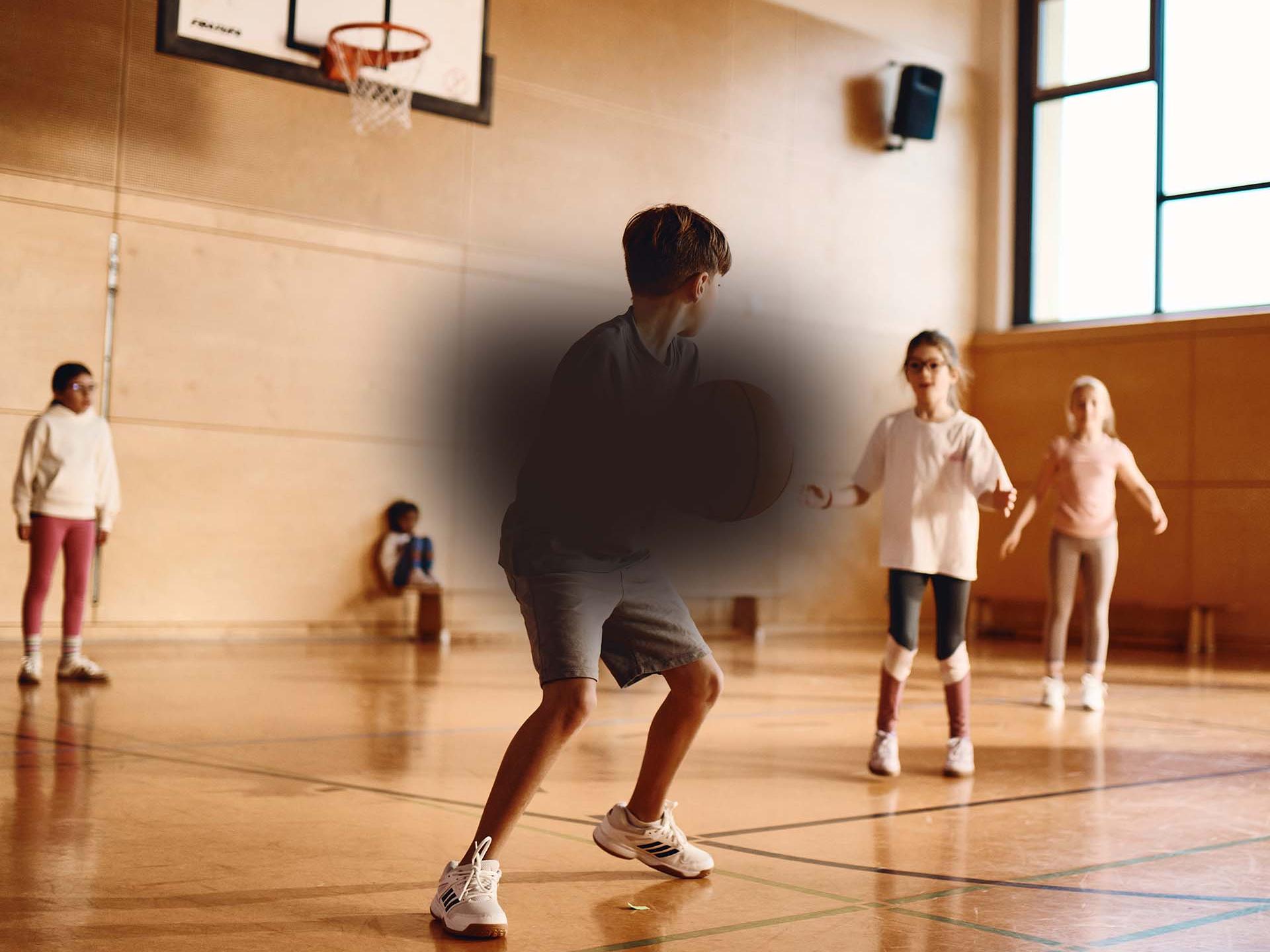
A loss of central vision or dark spot in the central visual field.
A point of view in a children’s PE class with a dark spot blocking the central visual field.
Frequently bumping into objects, missing steps or not noticing obstacles may indicate the gradual narrowing of side vision.
A busy moment in children’s PE class.

How to treat myopia.

The best approach to correcting myopia depends on a person’s age and the degree of their vision error.

Spectacle & contact lens solutions:
The easiest way to correct the myopic refractive error in both children and adults is with glasses or contact lenses. These use minus (–) powered lenses to refocus light onto the retina and restore clear distance vision.

Surgical solutions:
Some adults with myopia whose vision refraction isn’t worsening may want to stop wearing glasses and contact lenses altogether. Surgical solutions may be an option in such cases. Laser refractive procedures (e.g. photorefractive keratectomy (PRK), laser in situ keratomileusis (LASIK) or small incision lenticule extraction (SMILE), a phakic intraocular lens implantation or even a refractive lens exchange are possible solutions.

Both non-invasive and surgical treatments can reduce or even eliminate the refractive error, but they don’t reduce the long-term risks linked to high myopia.

In children and teenagers, it’s very important to intervene early to correct the refractive error  and control the progression of myopia.

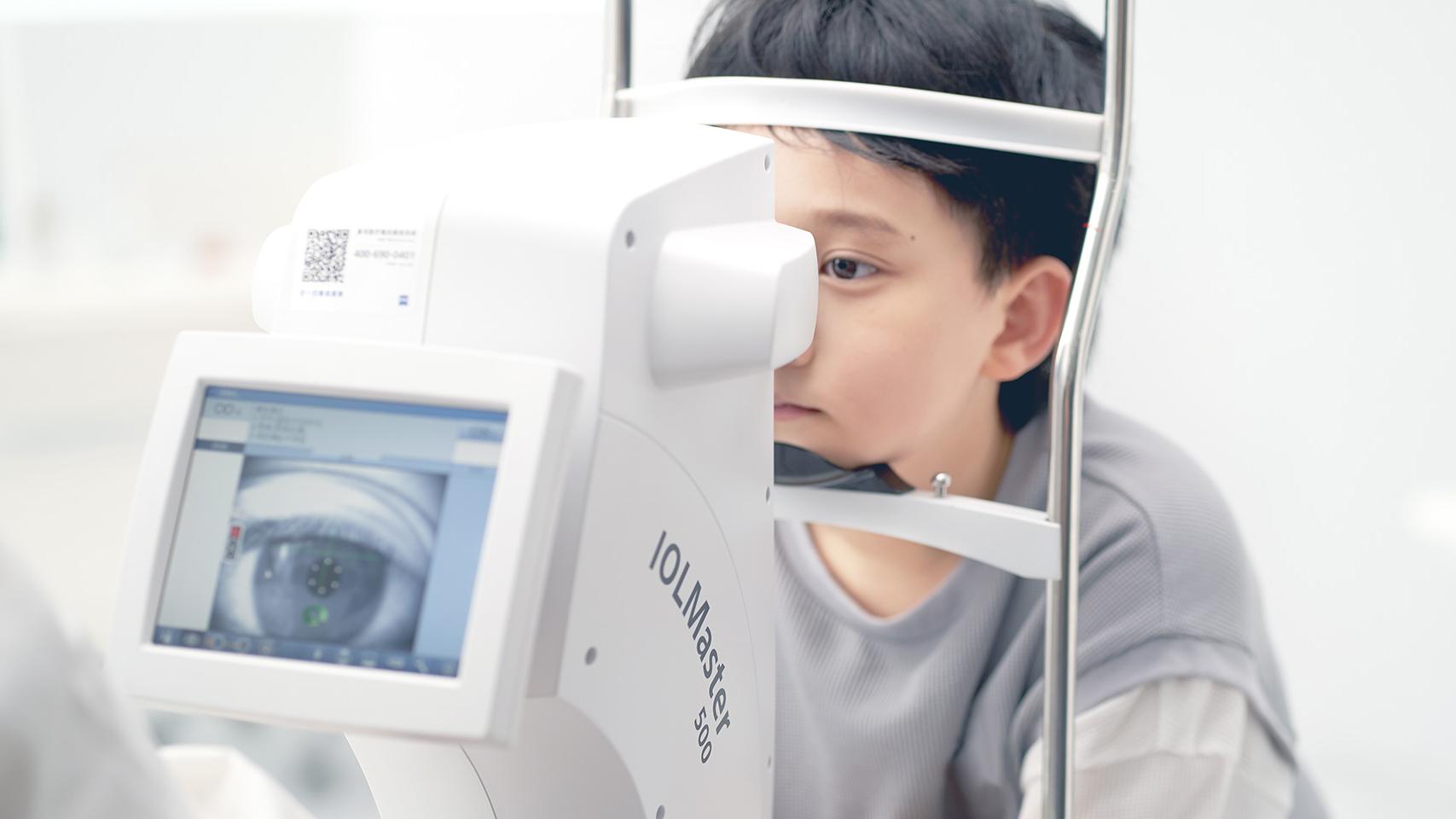
Eye doctors can help identify the best option for everyone’s eyes.

 A schematic illustration of the ZEISS MyoCare lens design with C.A.R.E. technology.

Managing myopia in children.

Recent years have seen a greater focus on myopia management in children and teenagers, which is designed to slow its progression and reduce the risk of complications later in life. Several options have proven effective:

  • Low-dose atropine eye drops used daily.14
  • Specially designed spectacle lenses,15-18 such as ZEISS MyoCare lenses – which show on average an absolute reduction of -0.31D in myopia progression.19
  • Multifocal, dual-focus or orthokeratology (ortho-k) contact lenses.20
  • Daily outdoor time and regular breaks from prolonged near work: The European Society of Ophthalmology suggests one to two hours outdoors daily and breaks after 30–45 minutes of reading or close activity.21

These strategies don’t "cure” myopia, but can significantly slow progression and help prevent issues caused by worsening high myopia.

What are the risks of not correcting myopia?

If myopia isn’t recognised and corrected early in children, it can interfere with their visual development. When one eye is significantly more myopic than the other, the brain may begin to rely more on the clearer eye. This can lead to amblyopia or ”lazy eye”, a condition in which one eye fails to develop normal vision.

Adults can and should wear glasses or contact lenses to correct blurred vision stemming from defocus. The main concern, however, lies in the long-term risks linked to high myopia. These include retinal detachment, myopic maculopathy, glaucoma and cataracts.

Detecting and treating myopia early as well as slowing its progression (when possible) can reduce the likelihood of these sight-threatening complications later in life.

A child without glasses sitting in class.

Make the right decision for your child’s vision.

At ZEISS, we believe that informed parents make the best choices for their children. This is why we offer valuable resources to help you understand myopia, the importance of early management and your options.

Common questions about myopia.

  • Farsightedness, also called long-sightedness or hyperopia, is a common refractive condition where near vision is often blurred while distance vision remains clear. Usually, this is because the eye is slightly shorter than average or its focusing components, such as the cornea or lens, aren’t strong enough to refract light adequately. As a result, the eye focuses light behind the retina instead of directly on it.22

    Other than hyperopia, myopia (nearsightedness, short-sightedness) usually occurs when the eye is slightly longer than average or its focusing light too strongly, leading to its focus point before the retina. This can cause objects in the distance to appear blurry while near vision is clear.4-7

  • Myopia, or nearsightedness, in children is an refractive error that makes distance objects appear blurred while up-close objects remain clear. Individual characteristics such as genetics, ethnicity and gender but also lifestyle and environment habits can increase the risk of myopia in children. So can spending extended periods of time on near-work tasks, studying or using digital devices for hours without spending enough time outdoors.9-11 Since myopia progresses with time, it’s important to track its development regularly and use personalised solutions to effectively slow its progression and protect your child’s visual health.

    If you child is myopic or shows signs of its early development, consult an eye care professional to measure, track and control myopia. 

  • The effects of myopia can worsen over time, especially if it is not recognized and its progression slowed early. In children, uncorrected nearsightedness can interfere with the child’s visual development and may lead to conditions like a “lazy eye”. Eye health risks linked to high myopia, like retinal detachment, myopic maculopathy, glaucoma, and cataract are possible long-term effects in adulthood.

  • There’s no cure for myopia today. But specific treatments can help slow its progression and prevent complications associated with advancing high myopia. Specific eyeglass lenses, contact lenses or surgical solutions such as laser refractive procedures can help depending on your individual case. The ZEISS eye care professionals in our network can help find the right solution for you or your child. 


  • 1

    Fricke TR, Jong M, Naidoo KS, Sankaridurg P, Naduvilath TJ, Ho SM, Wong TY, Resnikoff S. Global prevalence of visual impairment associated with myopic macular degeneration and temporal trends from 2000 through 2050: systematic review, meta-analysis and modelling. Br J Ophthalmol. 2018 Jul;102(7):855-862. doi: 10.1136/bjophthalmol-2017-311266. Epub 2018 Apr 26. PMID: 29699985; PMCID: PMC6047154.

  • 2

    Morgan IG, French AN, Ashby RS, Guo X, Ding X, He M, Rose KA. The epidemics of myopia: Aetiology and prevention. Prog Retin Eye Res. 2018 Jan;62:134-149. doi: 10.1016/j.preteyeres.2017.09.004. Epub 2017 Sep 23. PMID: 28951126.

  • 3

    Holden BA, Fricke TR, Wilson DA, Jong M, Naidoo KS, Sankaridurg P, Wong TY, Naduvilath TJ, Resnikoff S. Global Prevalence of Myopia and High Myopia and Temporal Trends from 2000 through 2050. Ophthalmology. 2016 May;123(5):1036-42.

  • 4

    Friedman NJ, Kaiser PK. Essentials of Ophthalmology. Philadelphia, PA: Elsevier Inc; 2007:253-254.

  • 5

    Ye Y, Aruma A, Zhao W, Lu ZL, Zhou X, Zhao J. A novel quick contrast sensitivity function test in Chinese adults with myopia and its related parameters. Graefes Arch Clin Exp Ophthalmol. 2023 Jul;261(7):2071-2080. doi: 10.1007/s00417-023-06010-7. Epub 2023 Feb 21. PMID: 36808230; PMCID: PMC10272261.

  • 6

    Poudel S, Jin J, Rahimi-Nasrabadi H, Dellostritto S, Dul MW, Viswanathan S, Alonso JM. Contrast Sensitivity of ON and OFF Human Retinal Pathways in Myopia. J Neurosci. 2024 Jan 17;44(3):e1487232023. doi: 10.1523/JNEUROSCI.1487-23.2023. PMID: 38050109; PMCID: PMC10860621.

  • 7

    Ávila, F.J.; Casado, P.; Ares, J. Photostress Recovery Time after Flash-Lighting Is Increased in Myopic Eyes. Photonics 2023, 10, 86.
    https://doi.org/10.3390/photonics10010086.

  • 8

    litcroft DI, He M, Jonas JB, Jong M, Naidoo K, Ohno-Matsui K, Rahi J, Resnikoff S, Vitale S, Yannuzzi L. IMI - Defining and Classifying Myopia: A Proposed Set of Standards for Clinical and Epidemiologic Studies. Invest Ophthalmol Vis Sci. 2019 Feb 28;60(3):M20-M30. doi: 10.1167/iovs.18-25957. Erratum in: Invest Ophthalmol Vis Sci. 2024 Nov 4;65(13):19. doi: 10.1167/iovs.65.13.19. PMID: 30817826; PMCID: PMC6735818.

  • 9

    Tedja MS, Haarman AEG, Meester-Smoor MA, Kaprio J, Mackey DA, Guggenheim JA, Hammond CJ, Verhoeven VJM, Klaver CCW; CREAM Consortium. IMI - Myopia Genetics Report. Invest Ophthalmol Vis Sci. 2019 Feb 28;60(3):M89-M105. doi: 10.1167/iovs.18-25965. PMID: 30817828; PMCID: PMC6892384.

  • 10

    Dutheil F, Oueslati T, Delamarre L, Castanon J, Maurin C, Chiambaretta F, Baker JS, Ugbolue UC, Zak M, Lakbar I, Pereira B, Navel V. Myopia and Near Work: A Systematic Review and Meta-Analysis. Int J Environ Res Public Health. 2023 Jan 3;20(1):875. doi: 10.3390/ijerph20010875. PMID: 36613196; PMCID: PMC9820324.

  • 11

    Kido A, Miyake M, Watanabe N. Interventions to increase time spent outdoors for preventing incidence and progression of myopia in children. Cochrane Database Syst Rev. 2024 Jun 12;6(6):CD013549. doi: 10.1002/14651858.CD013549.pub2. PMID: 38864362; PMCID: PMC11167692.

  • 12

    He X, Sankaridurg P, Wang J, Chen J, Naduvilath T, He M, Zhu Z, Li W, Morgan IG, Xiong S, Zhu J, Zou H, Rose KA, Zhang B, Weng R, Resnikoff S, Xu X. Time Outdoors in Reducing Myopia: A School-Based Cluster Randomized Trial with Objective Monitoring of Outdoor Time and Light Intensity. Ophthalmology. 2022 Nov;129(11):1245-1254. doi: 10.1016/j.ophtha.2022.06.024. Epub 2022 Jun 30. PMID: 35779695.

  • 13

    Lim R, Mitchell P, Cumming RG. Refractive associations with cataract: the Blue Mountains Eye Study. Invest Ophthalmol Vis Sci. 1999 Nov;40(12):3021-6. PMID: 10549667.

  • 14

    Ha A, Kim SJ, Shim SR, Kim YK, Jung JH. Efficacy and Safety of 8 Atropine Concentrations for Myopia Control in Children: A Network Meta-Analysis. Ophthalmology. 2022 Mar;129(3):322-333. doi: 10.1016/j.ophtha.2021.10.016. Epub 2021 Oct 22. PMID: 34688698.

  • 15

    Alvarez-Peregrina C, Sanchez-Tena MA, Villa-Collar C, Martinez-Perez C, de Corcuera-Terrero B, Liu N, Li W, Sankaridurg P, Ohlendorf A; Clinical Evaluation of MyoCare in Europe – the CEME Study Group. Clinical evaluation of MyoCare in Europe (CEME) for myopia management: One-year results. Ophthalmic Physiol Opt. 2025 Jun;45(4):1025-1035. doi: 10.1111/opo.13517. Epub 2025 Apr 29. PMID: 40296784; PMCID: PMC12087851.

  • 16

    Lam CS, Tang WC, Lee PH, Zhang HY, Qi H, Hasegawa K, To CH. Myopia control effect of defocus incorporated multiple segments (DIMS) spectacle lens in Chinese children: results of a 3-year follow-up study. Br J Ophthalmol. 2022 Aug;106(8):1110-1114. doi: 10.1136/bjophthalmol-2020-317664. Epub 2021 Mar 17. PMID: 33731364; PMCID: PMC9340033.

  • 17

    Bao J, Huang Y, Li X, Yang A, Zhou F, Wu J, Wang C, Li Y, Lim EW, Spiegel DP, Drobe B, Chen H. Spectacle Lenses With Aspherical Lenslets for Myopia Control vs Single-Vision Spectacle Lenses: A Randomized Clinical Trial. JAMA Ophthalmol. 2022 May 1;140(5):472-478. doi: 10.1001/jamaophthalmol.2022.0401. PMID: 35357402; PMCID: PMC8972151.

  • 18

    Rappon J, Chung C, Young G, Hunt C, Neitz J, Neitz M, Chalberg T. Control of myopia using diffusion optics spectacle lenses: 12-month results of a randomised controlled, efficacy and safety study (CYPRESS). Br J Ophthalmol. 2023 Nov;107(11):1709-1715. doi: 10.1136/bjo-2021-321005. Epub 2022 Sep 1. PMID: 36126105; PMCID: PMC10646852.

  • 19

    Chen, X., et al. (2024, May 5-9). Slowing myopia progression with cylindrical annular refractive elements (CARE) – 12-month interim results from a 2-year prospective multi-center trial [Conference presentation abstract]. The Association for Research in Vision and Opthalmology (ARVO) Annual Meeting, Seattle, WA, United States.

  • 20

    Lawrenson JG, Shah R, Huntjens B, Downie LE, Virgili G, Dhakal R, Verkicharla PK, Li D, Mavi S, Kernohan A, Li T, Walline JJ. Interventions for myopia control in children: a living systematic review and network meta-analysis. Cochrane Database Syst Rev. 2023 Feb 16;2(2):CD014758. doi: 10.1002/14651858.CD014758.pub2. Update in: Cochrane Database Syst Rev. 2025 Feb 13;2:CD014758. doi: 10.1002/14651858.CD014758.pub3. PMID: 36809645; PMCID: PMC9933422.

  • 21

    Tapasztó B, Flitcroft DI, Aclimandos WA, Jonas JB, De Faber JHN, Nagy ZZ, Kestelyn PG, Januleviciene I, Grzybowski A, Vidinova CN, Guggenheim JA, Polling JR, Wolffsohn JS, Tideman JWL, Allen PM, Baraas RC, Saunders KJ, McCullough SJ, Gray LS, Wahl S, Smirnova IY, Formenti M, Radhakrishnan H, Resnikoff S, Németh J; SOE Myopia Consensus Group. Myopia management algorithm. Annexe to the article titled Update and guidance on management of myopia. European Society of Ophthalmology in cooperation with International Myopia Institute. Eur J Ophthalmol. 2024 Jul;34(4):952-966. doi: 10.1177/11206721231219532. Epub 2023 Dec 12. PMID: 38087768; PMCID: PMC11295429.

  • 22

    Kanski, J. J., Bowling, B., Nischal, K. K., & Pearson, A. (2016). Clinical Ophthalmology: A Systematic Approach (8th ed.). Elsevier.